
Blog
EcoFlow vs Bluetti vs Yoshino: Which Portable Power Station Should You Buy?

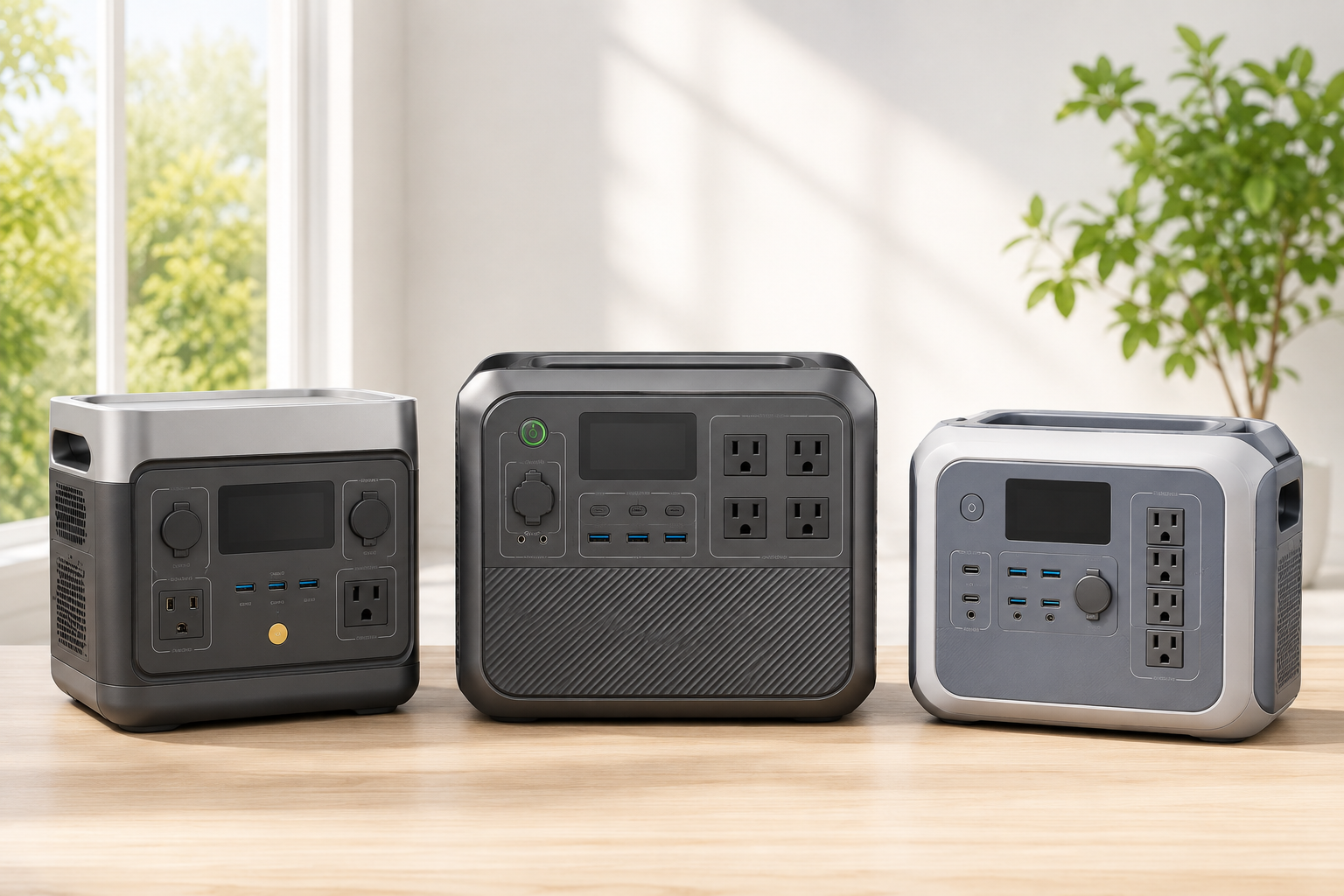
EcoFlow vs Bluetti vs Yoshino: Which Portable Power Station Should You Buy in 2026?
Portable power stations have come a long way. In 2026, EcoFlow, Bluetti, and Yoshino offer some of the most capable units ever made — but they serve very different needs. This guide cuts through the specs to help you pick the right one for camping, home backup, or off-grid living.
📋 Table of Contents
- What Is a Portable Power Station?
- Step 1: Know Your Use Case
- Step 2: Understand the Key Specs
- EcoFlow: Best for Fast Charging & Smart Features
- Bluetti: Best for Value & Expandability
- Yoshino: Best for Solid-State Innovation
- Full Comparison Table
- Why LFP Battery Chemistry Matters in 2026
- Which Brand Is Right for You?
1. What Is a Portable Power Station?
A portable power station is a large rechargeable battery with built-in AC outlets, USB ports, and DC outputs — essentially a generator that runs silently, produces zero emissions, and can be used indoors. Unlike traditional gas generators, portable power stations can be charged from a wall outlet, solar panels, or even your car, and they’re ready to power everything from your phone to a full-size refrigerator depending on their capacity.
In 2026, the category has matured significantly. Battery capacities have increased, charging speeds have become dramatically faster, and LFP (lithium iron phosphate) chemistry — which lasts far longer and is inherently safer than older lithium-ion — has become the standard in mid-range and premium models.
2. Step 1 — Know Your Use Case
Before looking at any brand or model, identify what you actually need to power. This determines the capacity (Wh) you need more than any other factor:
256 – 800Wh
1,000 – 2,000Wh
2,000 – 3,600Wh+
3,600Wh+ expandable
💡 Quick Rule of Thumb
To estimate how long a station will run an appliance: divide the station’s capacity (Wh) by the appliance’s wattage (W). A 1,000Wh station running a 100W device will last roughly 8–10 hours (accounting for efficiency losses). Always check the wattage of your most power-hungry device first.
3. Step 2 — Understand the Key Specs
Portable power station specs can be confusing. Here’s what actually matters:
- Capacity (Wh — Watt-hours): How much total energy the station stores. Think of it as the size of the tank. More Wh = longer runtime.
- Output (W — Watts): How much power it can deliver at once. Must be higher than the wattage of whatever you’re plugging in. A 1,800W output can run most appliances; under 1,000W limits your options.
- Charge Speed: How fast the station recharges from a wall outlet. In 2026, quality units charge from 0–100% in under 1–2 hours. Older or budget models can take 5–10 hours.
- Battery Chemistry: LFP (LiFePO4) is the 2026 standard for quality units — safer, longer-lasting (3,000–6,000+ cycles), and more stable in heat. Avoid older NMC lithium-ion for long-term use.
- Expandability: Some stations support add-on battery packs to increase total capacity without buying a new unit.
- Ports: Count AC outlets, USB-A, USB-C (check for 100W PD), DC, and car ports — make sure the station covers everything you need.
4. EcoFlow: Best for Fast Charging & Smart Features
EcoFlow
The speed and smart ecosystem leader
Best for: Speed, smart features & expandabilityEcoFlow has established itself as the benchmark for charging speed in the portable power station market. Their X-Stream technology delivers full charges in as little as 50–80 minutes — faster than any competitor by a meaningful margin. Beyond speed, EcoFlow’s app is widely considered the best in the category: real-time watt graphs, scheduled charging, remote monitoring, and integration with their broader smart home ecosystem. Their DELTA series (DELTA 2, DELTA 3 Plus, DELTA Pro 3) covers the full range from 1kWh camping units up to expandable 5kWh+ home backup systems.
✅ Pros
- Industry-leading charge speed (50–80 min)
- Best-in-class app & smart features
- Wide product range from 256Wh to 3.6kWh+
- Expandable capacity with add-on batteries
- Strong solar input — up to 996W average
- LFP battery chemistry on all major models
❌ Cons
- Premium pricing vs competitors
- Some models use proprietary connectors
- Heavier than equivalently-sized Jackery units
5. Bluetti: Best for Value & Expandability
Bluetti
The value and longevity champion
Best for: Value, home backup & long cycle lifeBluetti has consistently positioned itself as the value leader among premium portable power station brands. Their Elite series — launched in 2025–2026 — delivers a major leap in cycle life, with units rated for 6,000+ charge cycles (roughly 17 years of daily use). Bluetti also leads in expandability: their mid-range units can scale up to 8kWh+ with add-on battery packs at a lower cost per Wh than most competitors. For homeowners planning a serious backup power setup or anyone who wants maximum longevity from their investment, Bluetti is hard to beat.
✅ Pros
- Best value — lowest cost per Wh
- 6,000+ cycle LFP batteries (Elite series)
- Best expandability — scale to 8kWh+
- Wide solar voltage input (10–145V)
- Excellent for home backup & RV living
- Strong mid-range lineup (AC70, AC180, AC200L)
❌ Cons
- Slower wall charging than EcoFlow
- Heavier units in the high-capacity range
- App not as polished as EcoFlow’s
6. Yoshino: Best for Solid-State Innovation
Yoshino
The solid-state battery innovator
Best for: Safety-first buyers & next-gen techYoshino stands apart from EcoFlow and Bluetti by pioneering solid-state battery technology in their portable power station lineup. Solid-state batteries eliminate the liquid electrolyte found in conventional lithium batteries, making them significantly safer — with no risk of electrolyte leakage — and more stable across a wider temperature range. For buyers who prioritize safety above all else, or who operate in extreme temperature environments, Yoshino offers a compelling option that the mainstream brands haven’t matched yet.
✅ Pros
- Solid-state battery — safest chemistry available
- No liquid electrolyte — no leakage risk
- Excellent thermal stability in extreme temps
- Innovative, next-generation technology
- Unique positioning for safety-critical applications
❌ Cons
- Smaller product range than EcoFlow or Bluetti
- Premium price for solid-state tech
- Less ecosystem / accessory support
- Fewer independent long-term reviews
7. Full Comparison Table
| Feature | EcoFlow | Bluetti | Yoshino |
|---|---|---|---|
| Best For | Speed & smart features | Value & expandability | Safety & innovation |
| Battery Chemistry | LFP (LiFePO4) | LFP (LiFePO4) | Solid-State |
| Cycle Life | 3,000–3,500 cycles | 6,000+ cycles (Elite) | High (solid-state) |
| Wall Charge Speed | 50–80 min (X-Stream) | 2–3 hours (varies) | Varies by model |
| Max Solar Input | Up to 996W avg | Up to 753W avg | Varies by model |
| Expandable Capacity | Yes — up to 5kWh+ | Yes — up to 8kWh+ | Limited |
| App Quality | Best in class | Good | Basic |
| Value / Cost per Wh | Premium | Best value | Premium |
| Safety | Excellent (LFP) | Excellent (LFP) | Best (solid-state) |
| Product Range | Very wide | Very wide | Focused |
8. Why LFP Battery Chemistry Matters in 2026
If you’re buying a portable power station in 2026, LFP (lithium iron phosphate) should be your minimum standard. Here’s why it matters:
- Cycle life: Standard lithium-ion batteries last 300–500 cycles before significant capacity degradation. LFP batteries last 3,000–6,000+ cycles — up to 10–17 years of daily use.
- Safety: LFP chemistry is inherently more thermally stable than standard lithium-ion. It doesn’t overheat or enter thermal runaway under normal use conditions.
- Long-term storage: LFP holds its charge better during storage and doesn’t degrade as quickly when stored at partial charge.
- Temperature tolerance: LFP performs better in both cold and hot environments compared to older lithium-ion chemistry.
⚠️ Watch Out for Budget Brands
Many cheap portable power stations sold online still use older NMC (nickel manganese cobalt) lithium-ion cells, which have much shorter lifespans and higher safety risks. Always check the battery chemistry listed in the specs. If it doesn’t say LFP or LiFePO4, ask before you buy.
9. Which Brand Is Right for You?
✅ Quick Decision Guide
Choose EcoFlow if fast charging is your top priority, you want the best app experience, or you’re building a smart home power ecosystem.
Choose Bluetti if you want the best value per watt-hour, the longest battery lifespan, or you’re planning a home backup or off-grid system you’ll expand over time.
Choose Yoshino if you prioritize cutting-edge battery safety, operate in extreme temperatures, or want to invest in next-generation solid-state technology.
| Your Situation | Best Pick |
|---|---|
| Weekend camping trips, need fast recharge between trips | EcoFlow DELTA 2 or River 2 Pro |
| Home power backup — want to expand capacity over time | Bluetti AC180 or AC200L |
| Full-time RV or van life — need daily reliability for years | Bluetti Elite Series |
| Safety-conscious buyer, extreme temperatures | Yoshino Solid-State Series |
| Smart home integration, app control, solar power system | EcoFlow DELTA Pro 3 |
| Best value for the money — budget-conscious buyer | Bluetti AC70 or AC180 |
Shop Portable Power Stations at Ovreal
Browse EcoFlow, Bluetti, and Yoshino power stations — genuine brands, free U.S. shipping, delivered to your door.
Browse Power Stations →