
Blog
Riding Mower vs Zero-Turn vs Push Mower: Which Is Right for Your Lawn ?

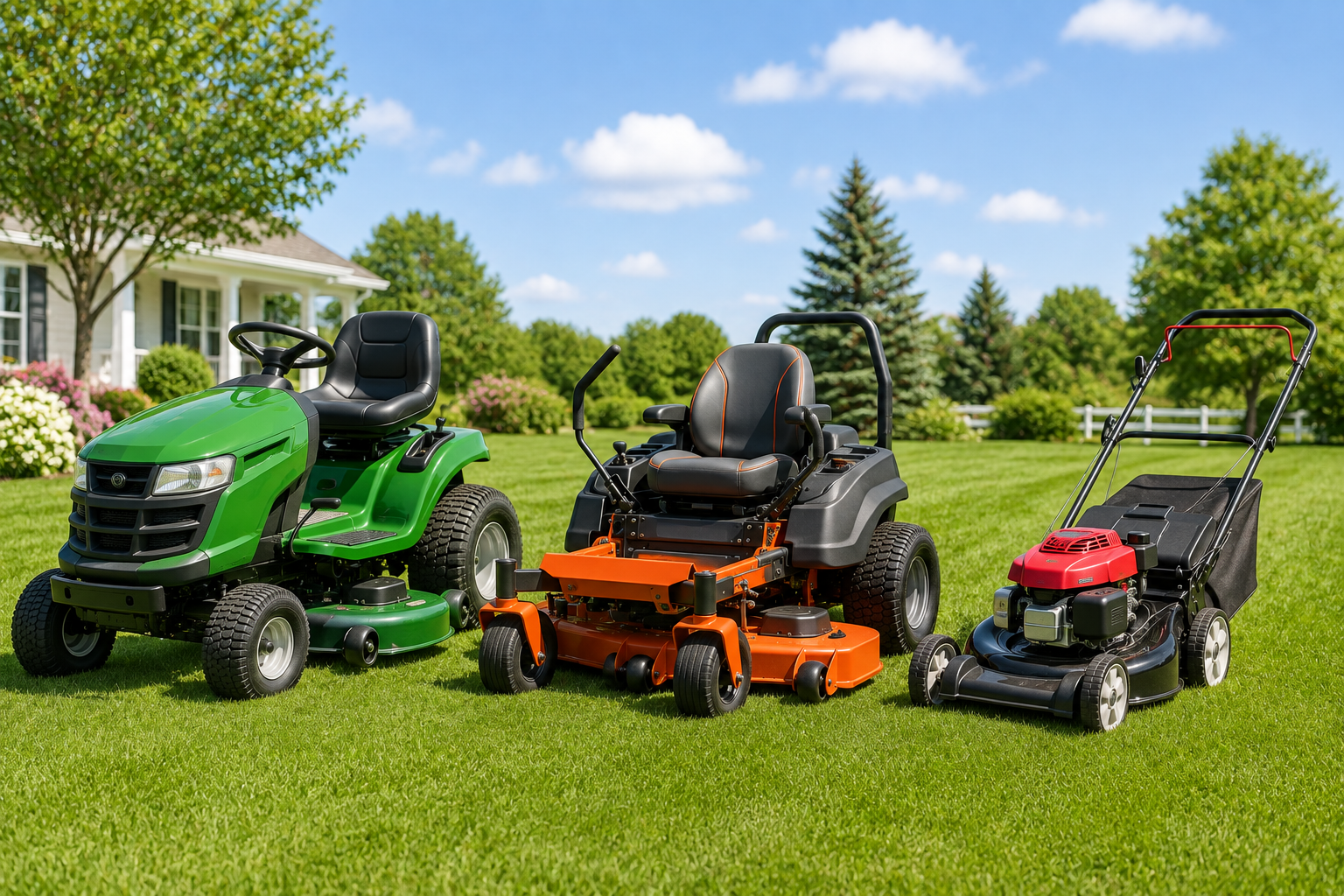
Riding Mower vs Zero-Turn vs Push Mower: Which Is Right for Your Lawn in 2026?
Choosing the wrong lawn mower is one of the most common — and most expensive — mistakes homeowners make. This complete buying guide matches the right mower type to your lawn size, terrain, and budget so you get it right the first time.
📋 Table of Contents
1. Start Here: What Size Is Your Lawn?
Before anything else — deck size, engine horsepower, gas vs electric — your lawn size is the single most important factor in choosing a mower. The biggest mistake buyers make is over-buying: purchasing a riding mower for a lawn that a self-propelled walk-behind would handle just fine, or under-buying and spending three hours mowing two acres with a push mower every week.
Use this as your starting point:
💡 Pro Tip: Measure Before You Shop
Most homeowners overestimate their lawn size. Use Google Maps satellite view to outline your yard and get a rough square footage — then convert to acres (1 acre = 43,560 sq ft). You might find you need a smaller mower than you thought, and save hundreds of dollars.
2. Push & Self-Propelled Mowers
Push & Self-Propelled Mowers
Best for: Under ½ acrePush mowers are the most affordable and lowest-maintenance option for small yards. A standard push mower requires you to provide all the forward motion yourself, while a self-propelled mower drives itself forward — you just guide it. For lawns under half an acre, a quality self-propelled mower is usually all you need and will save you thousands compared to a riding mower.
✅ Pros
- Most affordable option ($200–$600)
- Easy to store in small spaces
- Low maintenance — fewer parts
- Good exercise for flat lawns
- Electric models are quiet & low-maintenance
❌ Cons
- Slow on larger lawns
- Physically tiring on slopes
- Not suited for lawns over ½ acre
- Narrower cutting deck = more passes
3. Riding Lawn Mowers & Tractors
Riding Mowers & Lawn Tractors
Best for: ½ acre – 1½ acresRiding mowers and lawn tractors are the classic choice for medium-sized properties. They use a traditional steering wheel, feel familiar to drive, and are more stable on hills than zero-turns. Beyond mowing, many models can tow trailers, pull aerators, and attach snowblowers — making them a true multipurpose yard tool. Brands like MTD, Cub Cadet, and Husqvarna offer excellent options in this category.
✅ Pros
- Intuitive steering wheel — easy to learn
- More stable on hills & uneven terrain
- Can tow and use attachments
- Good mid-range price ($1,200–$3,500)
- Excellent for open, straightforward lawns
❌ Cons
- Slower than zero-turns
- Larger turning radius = uncut corners
- Less maneuverable around obstacles
- Takes more passes near landscaping
4. Zero-Turn Mowers
Zero-Turn Mowers
Best for: 1½+ acres with obstaclesZero-turn mowers are the fastest, most maneuverable riding mowers available. Instead of a steering wheel, they use two lap bars — pushing one forward while pulling the other back causes the mower to spin in place, enabling a true 180-degree turn with zero uncut grass. If you have a large lawn with trees, flower beds, fences, and obstacles, a zero-turn will cut your mowing time significantly compared to a tractor.
✅ Pros
- Fastest mowing speed available
- Perfect 180° turns — no missed strips
- Cuts tight around obstacles & beds
- Wide deck options (42″–60″+)
- Professional-quality finish
❌ Cons
- Steeper learning curve — lap bars
- More expensive ($2,500–$7,000+)
- Can slide on slopes over 15°
- Not ideal for towing heavy loads
- Overkill for lawns under 1 acre
⚠️ Zero-Turn & Slopes: Know the Limit
Most manufacturers recommend against using zero-turn mowers on slopes steeper than 15 degrees. On steep hills, zero-turns can lose traction and slide sideways — a riding tractor is significantly safer for hilly terrain. If your yard has steep grades, choose a riding mower over a zero-turn.
5. Gas vs Electric: Which Power Source Wins in 2026?
The gas vs electric debate has shifted dramatically in 2026. Battery-powered mowers — especially riding models — have improved to the point where they now match or outperform gas models in many real-world tests, according to Consumer Reports testing. Here’s how they compare:
Gas Mowers
- Unlimited runtime — just refuel and keep going
- More power options for heavy-duty and commercial use
- Higher maintenance — oil changes, spark plugs, air filters, carburetors
- Louder, produces emissions
- Better for very large properties where battery range is a concern
Electric / Battery Mowers
- Near-zero maintenance — no oil, no fuel, no pull-starts
- Much quieter — ideal for early morning mowing
- Lower long-term operating costs
- Instant torque — strong performance from the start
- Runtime improving rapidly — many models now handle 1–2 acres per charge
- Simply swap batteries to continue — no trips to the gas station
✅ 2026 Verdict
For most homeowners with lawns up to 1.5 acres, a battery-powered mower is now a genuinely excellent choice — quieter, lower maintenance, and increasingly on par with gas performance. For larger properties or heavy commercial use, gas still holds the edge in raw runtime and availability.
6. Full Comparison Table
| Feature | Push / Self-Propelled | Riding Mower | Zero-Turn |
|---|---|---|---|
| Best Lawn Size | Under ½ acre | ½ – 1½ acres | 1½+ acres |
| Price Range | $200 – $600 | $1,200 – $3,500 | $2,500 – $7,000+ |
| Mowing Speed | Slow | Medium | Fast |
| Maneuverability | Good | Moderate | Excellent |
| Hill Safety | Good | Best | Limited (max 15°) |
| Attachment / Towing | No | Yes | Limited |
| Learning Curve | None | Easy | Moderate (lap bars) |
| Maintenance Level | Low | Medium | Medium-High |
| Storage Space Needed | Small | Large | Large |
7. What About Hills and Slopes?
Terrain matters just as much as size when choosing a mower. Here’s the quick guide:
- Flat lawns: Any mower type works — choose based on size alone
- Gentle slopes (under 10°): All riding mowers handle these fine
- Moderate slopes (10–15°): A riding tractor is recommended over a zero-turn
- Steep slopes (over 15°): Use a self-propelled walk-behind with rear-wheel drive — it gives you the most control and is the safest option on steep grades
If your property has a mix of flat areas and steep slopes, many homeowners use a zero-turn for the flat sections and a self-propelled mower for the hills — getting the best of both worlds.
8. Quick Buying Checklist
Before you buy, run through this checklist:
- ☑️ Measure your lawn — don’t guess your acreage
- ☑️ Check your terrain — flat, rolling, or steep slopes?
- ☑️ Count your obstacles — trees, beds, fences? Consider a zero-turn
- ☑️ Decide on power source — gas for large properties, electric for smaller lawns and low maintenance
- ☑️ Choose cutting deck size — wider decks cut faster but need more storage space
- ☑️ Check for towing needs — need to haul a trailer or run attachments? Choose a riding tractor
- ☑️ Set a realistic budget — include long-term maintenance costs, not just purchase price
- ☑️ Buy from a trusted source — ensure the product is brand-authentic with manufacturer warranty
Shop Lawn Mowers at Ovreal
Browse our full range of genuine riding mowers, zero-turn mowers, and push mowers from trusted brands like MTD and Cub Cadet — free shipping on all U.S. orders.
Browse Lawn Mowers →